Showing posts with label scam. Show all posts

Monday, November 7, 2016

OneCoin round 2 - it's all about the "family" and merchants

The saga of OneCoin continues. We've talked about the issues they might be running into with using big numbers for their currency, how market cap or coin supply is essentially meaningless, and now let's analyse the actual OneLife Mastermind Bangkok Event.

What was the event about?


Looking at the three hour long video of the event, there is a lot to cover. All of it strikes an uncanny resemblance to a Multilevel Marketing event:


We have a lot of pomp, a lot of hype, bragging, talking about how everyone is forming a giant "family" and asking them to start buying and peddling the newest product - merchant applications. There is a lot of small pieces of information here and there on how they envision their system working, and a lot of it raises red flags.

The event certainly packed a lot of showmanship - live musical performances, important sounding speakers and so on. I've been to a few cryptocurrency conferences already, and they are completely different - you hear a lot about the technology, new developments, etc., and there is a lot less cult of personality.

Merchant program


One of the more important but overlooked parts of the event was the news about OneCoin's new merchant program. There are two new packages being sold - one for $1000 that comes with one whitelabel application, and a $5500 one that comes with seven applications. OneCoin expects its members to purchase those applications and sign up merchants, giving them those applications. Their goal is to reach one million merchants in the coming years. With the merchant adoption, the coin is supposed to gain liquidity and value.

Why should the merchants join? To gain access to OneCoin's "family" and the network, and they incur no cost for the first year. The coin should be "very stable" and merchants "should prefer it to PayPal, Visa, Mastercard".

So yes, the merchant program is as they say "free", and by free, they mean it costs $1000 to the person that signs up the merchant. So the marketing and on-boarding the merchants falls on the coin users that also get to pay for the privilege. But at least you will finally have some place to spend your OneCoins, right?

Well, not quite. The merchants will be able to specify how many OneCoins they will be accepting. They can choose to accept, say, 20% of the payment in OneCoin and 80% from the user's Credit Card (conveniently connected to the account already). This implies that OneCoin doesn't even do the most basic thing that every Bitcoin payment processor does - sell the coins for the merchant and pay them in fiat.

So let's compare that to say, BitPay, one of Bitcoin's oldest payment processors. It allows you to sign up for free, it's free to use for some small volume transactions, or it costs the merchant 1% otherwise. You can accept Bitcoin for 100% of the purchase and you get all of your money in whatever form you want - BTC, wire, etc. For OneCoin, you need to have someone else pay $1000 for the application, sign you up, then you specify how much OneCoins you will be accepting for every transaction, then you have to figure out how to cash those out (without a real exchange yet), and you might be charged something after a year of using it.

So yeah, it doesn't look good - more like a barely serviceable product that you want your current members to buy and convince people to use to make their coin accepted somewhere and thus gain value. It's a good MLM strategy, but terrible usability strategy.

Other things


We've already covered the coin doubling event, so there isn't much more to cover in that regard. It's silly, watching people get excited for a 100% increase in coin supply without an increase in coin's value. So instead, here is a list of various pieces of information that were stated thorough the event:

  • There have been 14 million accounts created, with 2.5M active distributors
  • The price of the coin was 50 eurocents, now it is 9 euros, and they aim to get to 25 euros
  • OneCoin is launching some social media website called OneSaito, which will feature Groupon-like discounts. So it's like 2010
  • "To make sure we continue to produce coins, we need tokens, and tokens come from product packages"
  • They want to achieve critical mass in a year's time
  • "We will eventually move to the next stage when what we're doing will become self-evident" - do they mean people will catch on to the MLM structure?
  • "We don't want to create idiots"
  • "Any one of you could've launched Pokemon Go"
  • Whoever maxes out their 35k Euro contribution on the day of the event will have the opportunity to max out another 35k Euro contribution the following day
  • "So guys in Sofia, if you don't switch it on, we'll come for you and kill you, yeah? Always good to motivate the office too..."
  • OneCoin will be going into the remittance business (so they're joining the Bitcoin hype from a few years ago that has already been explored by 19+ companies?)
  • OneCoin will be going public in Q2 2018
  • OneLife has created 350 millionaires in its history. There were 450 diamonds in the event
  • OneCoin is a special network, because it acts "like a family"

Conclusions


OneCoin is quite obviously a MLM pyramid scheme. Quite brilliant actually - instead of peddling products people have to start storing in their garages and try to sell to other people, they are selling a "crypto" currency and telling everyone to buy as much as they can to raise it's value. They have virtually no production costs, therefore every dollar spend is essentially profit. Instead of investing that money into development of some actual products, like exchanges, payment processors, etc., they just get people to buy into the scheme more and more, to promote the coin further to drive the sales.

The most symbolic part of the event came in around 2:35. The speakers talk about celebrating OneCoin's second birthday with a cake, "the largest cake ever" - OneCoinCake. 2x2 meters in diameter. Unfortunately, since there were 11500 people in the audience during the event, "not everyone will get to taste the cake". This is perhaps a good analogy to how OneCoin works - everyone pays for the cake, you make a large cake, and the elites will stuff themselves while everyone else will only get to admire the cake from afar...

Related links:

Tuesday, October 11, 2016

Big numbers don't mean big money

Last week we discussed problems with using really big numbers in cryptocurrencies. This week I'd like to talk about misconceptions surrounding cryptocurrencies with big coin supply as well as inflation in cryptocurrencies.

Coin supply is a joke


Both this and the previous article were inspired by the OneLife Mastermind event, during which the people on stage were gushing about how many coins their system will have and can mine.

"The new blockchain will mine 50'000 coins per minute. [...] I think we are mining about 2'000'000'000 coins now."

In their previous event, they've stated

"Biggest coin out there is Ripplecoin [sic], with 100 billion coins[sic]", and OneCoin will increase its number of coins to 120 Billion to be bigger than Ripple.  

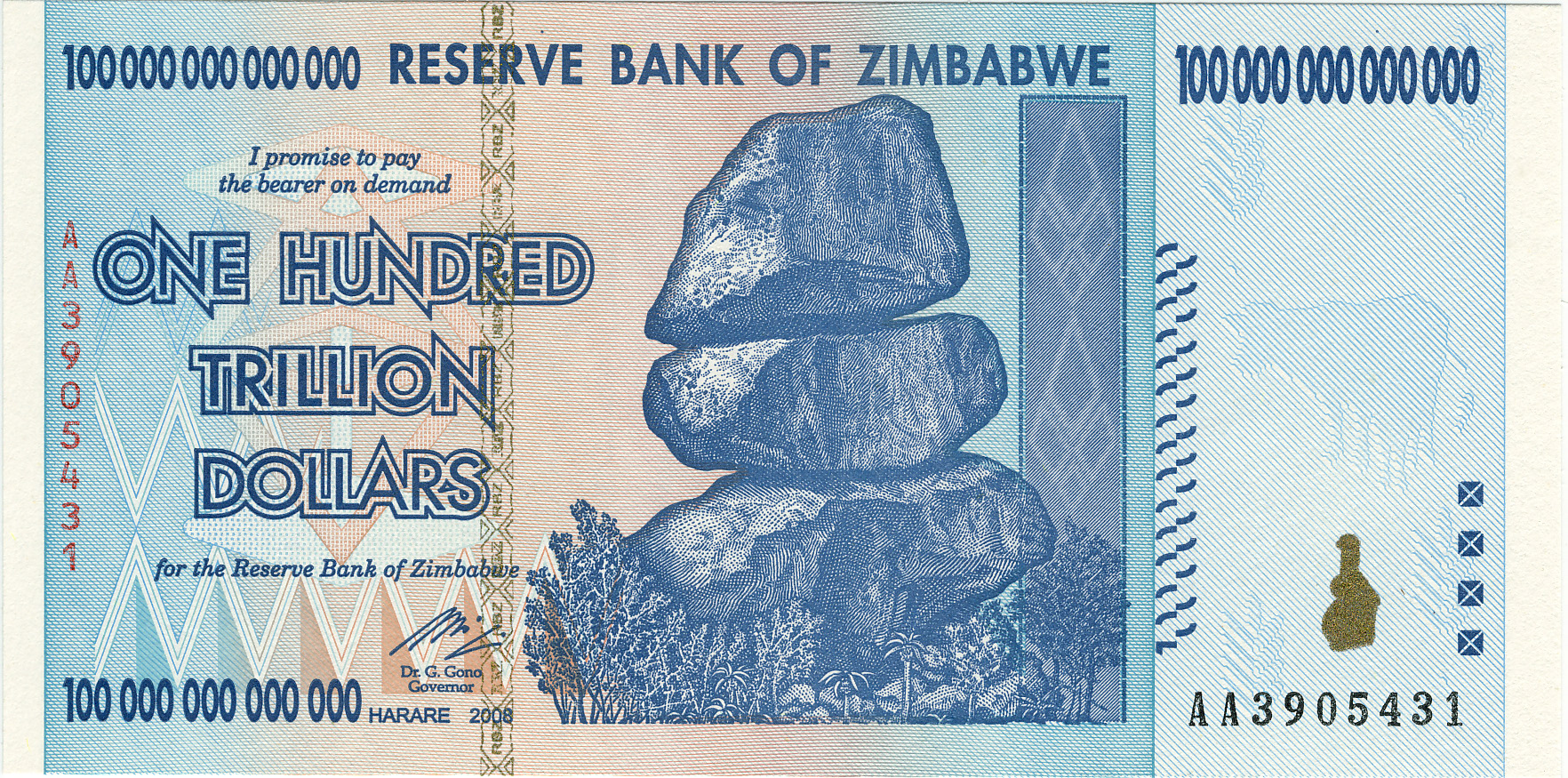
Focusing on the amount of coins you are mining or the coin supply is a joke. It's like praising Zimbabwe for producing 100T dollar notes, or the post WW1 Germany for having so much money you can build toy houses with them.

Market cap is deceptive


A lot of people rely on the market cap to determine which coin is the most valuable and worthwhile. Just have a look at CoinMarketCap. At the moment we have Bitcoin leading the market cap of about $10B, followed by Ripple at $1.2B.

Right at position number 2, we have an issue calculating the market cap - Ripple's available supply is listed at 35B XRP, although its total supply is shy of 100B XRP. If we calculated the market cap blindly, we should take the total supply and multiply it by the current price (0.0035 USD/XRP), which would net us $3.6B, rather than $1.2B.

The market cap is a poor metric for a coin with a highly-centralised supply. As Peter Todd jokingly put it - just mine a large amount of coins, sell a few of them at a high price and you've got a huge market cap.

It would be really hard to create some metric that can measure how valuable a cryptocurrency network is - market cap can be inflated, volume can be faked or hidden, you can't ever know how much of the coin supply is held by a handful of people with a million addresses, etc.

Inflation is not growth


In the past I've seen some deceptive advertising for a proof of stake coin that claimed it was a savings currency. They justified it by essentially saying - "buy our coin, then you can stake it and earn X% per year with it". While on surface it might appear so - if I start with 100 coins and at the end of the year I get 110 coins, then I'm 10 coins richer, right?

That works only on paper. If the market cap for the cryptocurrency remained unchanged and everyone got their 10% more coins, then you're right where you started - you own the exact same percentage of the economy as you used to. The inflation ate your earnings.

In economics, there is an important distinction between nominal and real interest rates. If I take a loan at 5% (nominal) interest rate, but the inflation is at 3%, then I effectively only pay a 2% (real) interest rate on the loan. Each year the principal of my loan has lower and lower purchasing power even if the number remains steady. The same is true for proof of stake inflationary coins - you're not earning anything with them, unless the pace of your earnings is faster than the overall inflation of the network.

A coin will only net you revenue if its equivalent of "real GDP" increases:


If you're not ahead, you're losing money


In an inflationary currency, if your supply of coins is growing slower than the average coin supply, you are essentially losing money. Earning 5% interest in a currency with 10% inflation means you are losing 5% on your investment in an ideal economy. In a real-life scenario, the markets would most likely be swayed a lot more by the speculation on the coin and whatever hype it can muster.

This point usually has low impact on most coins, but it seems to be exemplified with OneCoin's splits and tokens, assuming we would treat the coin as a real cryptocurrency and not a scam. In OneCoin, you can buy different packages that each come with a different amount of tokens and splits. If you buy the cheapest package for 110 EURO you get 1000 tokens and one split, but if you decide to spend 27'500 EURO, you get 300'000 tokens and three splits. This means that not only do you get about 20% discount on tokens when buying them in bulk, buy you can also split them more times (which I'm guessing would give you more mining tokens or something, I'm not sure). Because of this, if you're buying anything shy of the top-tier package, you're already falling behind. I guess that's why you can find a lot of "strategies" for buying the tokens everywhere...

Same goes for the doubling event, wherein everyone's coins got doubled (since 100% inflation equates to 100% growth or something...). If you missed that event, your purchases are only worth 50% of what they would've been before that event in proportion to the entire market. You can't ever catch up.

If you're late, you're paying the early adopters


Unless we're talking about cryptocurrencies with a flexible supply denominated in fiat, anyone adopting late is essentially paying the early adopters. In some cases, that's pretty justifiable - when Bitcoin was still fresh and nobody knew if it had staying power, you needed a lot of people to devote their time and energy into developing the infrastructure everyone relies on today.

However, if you look at something like OneCoin that relies heavily on hype and even pays you in a pyramid-like structure for referrals, you have to be really weary when buying into it.

This is why a lot of people in the crypto world despise premining and fast maturing coins - a few people hold a lot of coins and they get to reap the bulk of the money from anyone buying into the network. When the jig is up, they can cash out and it's the late adopters that get to hold the bags.

If OneCoin was an honest coin, I can see some people getting rich if and when the coin starts getting publicly traded and people can start dumping their coins. As it is now, it is likely that everyone with the coins will be holding the bags while the people behind the coin will be the one with the money.

Conclusions


Coin supply does not matter, market caps can be deceiving, nominal growth does not matter - only real growth, don't buy into scams.

Tuesday, July 26, 2016

How not to blockchain - a look at OneCoin

In the recent weeks there has been a resurgence of news about OneCoin, what appears to be a high-profile MLM ponzi scheme disguised as an altcoin. From what I can gather, the renewed popularity of the topic was sparked by OneCoin's Coin Rush Global Event:

Coin Rush Global Event

Watching this video as someone that has been around Bitcoin for 5 years now, there are more red flags here than you would see during International Workers' Day in some places. In fact, the video and OneCoin in general are such a good example of how you can bamboozle people by saying just the right thing that it might be a worthwhile exercise to dissect a lot of it.

The Basics


Going onto a cryptocurrency website you want to look for a few key pieces of information:

  1. Who is developing the project / the code? You want to find at least a competent development team identifying themselves. Examples: Bitcoin, Ethereum, Ripple. For OneCoin, the best resource I could come across was OneDream Team's "Top Leaders", which only boasts some news.
  2. Where is the company located? It is especially important for exchanges and other companies you're giving money to, but can be useful for the core development team if applicable. Examples: Ethereum (listed on the bottom page), Bitcoin FoundationBitStamp, not as much for Bitcoin Core (as it's a more decentralised development) Ripple, OneCoin or xcoinx.
  3. Where is the source code? If you can't see the code, you can't be sure what you're installing isn't malware or whether the blockchain itself is really there. Examples: Bitcoin, Ethereum, Ripple, but nothing for OneCoin.
  4. Is there a block explorer? If you can't browse the blockchain data and validate it yourself, how can you be sure everything adds up? Examples: Bitcoin, Ethereum, Ripple lacks a proper explorer, but has a public API endpoint. For OneCoin, best you can get is a falsi explorer (thank you /u/TimTayshun for the screenshot)
  5. Do any reputable exchanges trade it? A coin that isn't tradeable might not be a currency at all, but instead some "funny money". For a smorgasbord of examples, you can check out CoinMarketCap, indexing things as low as $8 market cap for COIN. OneCoin, despite boasting 5.2B USD market cap, is conspicuously missing...


Getting all five of the above points is a good start for any currency, but as we can see, even some of the largest coins are missing one or two of those features. Lacking all five does not bode well.

That's not how blockchain works


Putting all of that aside, let's look at the video proper and see what the event is about. Apparently the big news that day was that OneCoin is retiring it's old blockchain (!) and launching a new one in October so they can make more onecoins (!!). The justification being, and I kid you not, that they need more coins to grow, since there might not be enough coins for new merchants, Latin America, India, etc.

Let that sink in for a bit. A cryptocurrency that is not explicitly tied to a fiat currency is running out of coins for people. So instead of letting free market organically settle on a price it thinks the coins are worth and say, buying the coins from the market to give to the new merchants if they want, they instead decide to make more coins...


The issue is also more complicated than just that. OneCoin on its FAQ page claims its blockchain is mined with a custom solution based on Script and X11. However, you don't mine the blocks directly, instead "you just sign up on the mining dashboard on the exchange in your back office". This might remind some people of Proof of Stake or Delegated Proof of Stake, but no, OneCoin does it differently - "People are signed up and assigned to mining pools on a first come, first serve basis. Whenever a place is free you can join a pool.". The process appears to be:

  1. You send OneCoin money to buy the right to mine the coin
  2. You sign up to mine
  3. You wait for your turn to mine
  4. You get your coins
In other words, it's like purchasing coins from an exchange (send money, get coins), but with an arbitrary wait period (currently 3-6 MONTHS!) between sending money and receiving coins. As /u/TimTayshun pointed out, the block times are also very strange - too regular for a Bitcoin-like mining scheme. The blocks appear to be generated at the 10 minute mark without much variation. If there is any real mining going on, there is no real competition, no difficulty adjustment or anything like that. It looks a lot more like Ripple's Consensus algorithm than anything mining-related.


Splits and tokens


But even all of that is not the whole story. Enter the splits and tokens. You don't directly buy the onecoins, instead you buy packages that include tokens and splits:


Apparently in order to keep the price attractive, you split the tokens as you would company shares. In the end it means that you have a higher quantity of tokens that you can use for mining, but the value stays the same, I think. The splits apparently can only be used on the tokens, not the coins that are mined, and you can combo the various packages in some "strategy" to receive more and more splits.

This seems to accomplish a few things:

  • Make the process more opaque
  • Incentivise people to buy more and more packages to get the best value for their money
  • Make people feel like they are in control of how to get the most money and get ahead of everyone else
  • Widen the distance between real money and onecoins by extra few steps in a freemium-like model

So in other words, the entire system looks like a shady mobile app:

"Money, money, money money money money"

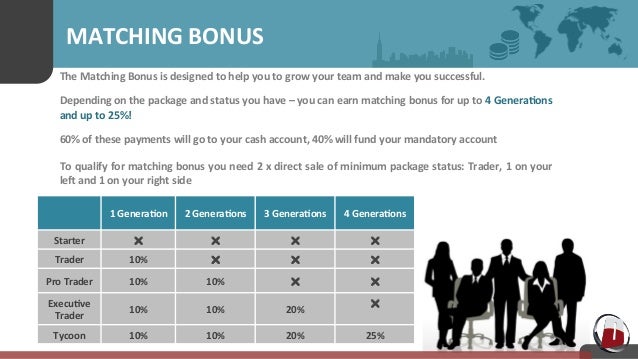
If that wasn't enough, you also can't forget about the match bonus for people you refer:
Because nothing inspires more confidence than a pyramid-like structure with the money flowing to the top...

There is also something about not actually purchasing tokens, but instead purchasing training from OneAcademy that conveniently comes with tokens, BVs and what have you, but at this point I think I made my point. Purchasing any cryptocurrency is simple - you take your money, you get your tokens. With OneCoin, a simple trade is a drawn out process taking many months with zero transparency. Mining is a joke, the numbers are multiplied over and over. But the story doesn't end there...

Show us your proof


During the Coin Rush Global Event, there have been a number of claims made about OneCoin and other coins as well. After hearing a lot of them, one feels the urge to shout "show us your proof". In no particular order:

  • OneCoin has 2 million active users, no other currency has as much - I would love to see a proof of that claim, since it not only asserts a lot of people are using OneCoin, but claims to know how many people are using other cryptocurrencies, which is an information that is hard to come by. Someone estimated Bitcoin to have 50M users by 2015, but that's a guess. How many people are actually active on Bitcoin or OneCoin, that would be interesting to know.
  • OneCoin has 4.5B USD market cap - seeing as the coins aren't actively traded at any reputable exchange and the blockchain is not verifiable, any number you throw out there is as valid as any other.
  • Bitcoin has almost no merchants taking it - there are 8000 physical locations taking Bitcoin today, in 2014 BitPay estimated the number to be over 20k. All in all, it would be interesting to see where the data is coming from, since it's not that easy to come by
  • OneCoin is in 195 countries, it's bigger than Western Union - It would be really interesting to see the actual list of their operations. There are 195 countries in the world, which means they would have to operate in the US, North Korea, Iran Sudan, Syria and Myanmar at the same time, violating a lot of international sanctions.
  • OneCoin can do more transactions than Visa and Mastercard combined - this would mean it can handle more than 2'000 transactions per second, it would be an impressive amount of data to synchronise in a blockchain
  • OneCoin stores all customer KYC information encrypted on the blockchain - this would not only be a huge customer data protection concern (blockchain by definition is shared between multiple parties, so all you need is a blockchain and encryption key leak and someone has compromised all of that data), but also an can be an issue of how decryption would be handled under a warrant
And from other sources:

The Icing on the Cake


Even after pointing out the various problems for a long while, there is still a lot more that needs to be addressed. Going into detail on everything would probably make this lengthy article probably twice as long. So let's finish off everything else in some quicker fashion. What follows are various claims, quotes and other titbits from the video presentation:

  • It takes over a year to mine one bitcoin - unless you're 21.co, nobody advocates Bitcoin mining to newcomers. Just like mining gold in real life, it's best left to professional companies
  • There are "Mickey Mouse coins" that copy OneCoin's concept - don't flatter yourself, everyone is aping Bitcoin
  • Just like you need a driver's license to drive a car, you need a drivers license for the cryptocurrencies - one of the beautiful things about Bitcoin is that it's inclusive - anyone can use it, you don't need a permission. While education is valuable, forcing people to go through a test before they can use cryptos is missing the point
  • OneCoin wants to be number 1 cryptocurrency world-wide in 2 years
  • When Bitcoin was one year old, it was worth 15 cents and nobody cared about it - it took two years for Bitcoin to be worth 15 cents, but now the speed at which good coins accelerate in price has increased thanks to Bitcoin. Dissing on the history to make your coin appear better is a false equivalence
  • OneCoin is one year old and it already wrote history - not really, but it will certainly write history once the jig will be up
  • They are aiming to have 20 million active users and 1 million merchants in 2 years
  • "We are the bigger community - we decide what the philosophy of cryptocurrency is"
  • The merchant / Latin America / India market capitalization is X trillions, OneCoin is only worth 5 billion, it simply does not work - normal coin would allow the price to grow to accommodate the market and use the 8 decimal places the coin has. Saying that you need to increase the amount of coins to grow is like saying you need to slice an apple into more pieces to make it bigger
  • "We can close new registrations, reject merchants... Or make more coins!"
  • "Biggest coin out there is Ripplecoin [sic], with 100 billion coins[sic]", and OneCoin will increase its number of coins to 120 Billion to be bigger than Ripple - that will still make you 3 times smaller than Fedoracoin, why not go for more?
  • You can't increase the amount with the current blockchain, need to retire the blockchain and launch a "new, more powerful blockchain" - you could, if your developers were up to snuff. Or maybe you're doing this to delete some old data from the old blockchain, or introduce some different balances that aren't supposed to be there?
  • Every account balance will be doubled after the blockchain is updated - again, increasing the numbers is not the same as increasing the value those numbers represent
  • When posting a question "will my coins be worth less after the update", the answer is not a clear "yes or no", but instead saying that the value of coins comes from brand and usability
  • Restaurant or retail store will never take Bitcoin - 8000 times false
  • "OneCoin will write history, and the cryptocurrency comminuty will have to rewrite philosophy"
  • "In 2 years nobody will speak of Bitcoin anymore"
And finally - "OneCoin Cryptocurrency is Unique, Safe, Global & With No Risk of Inflation", other than the doubling of the coins, the extra amount of coins that will be pumped into the system after the switch, etc. Those little things.

The Ecosystem


OneCoin, officially based in Dubai, boasts an impressive "ecosystem", consisting of 10 distinct items:

OneCoin's ecosystem

  • OneAcademy, an e-learning platform teaching about tarding, stock exchange, cryptocurrency, etc. in a 6-level program, boasting over 2'000'000 students and supporting 231 out of the current 195 world countries
  • OneExchange, currently not online
  • OneLife Network - "a digital platform with a unique ecosystem of sophisticated products and social networking tools that help members achieve financial independence", whatever that's supposed to mean. But fret not, they will offer you an "Ultimate Trader Package" for  the low low price of 118'000 EUR, and a tablet to match for 550EUR, only 5-6 times more expensive than a comparable tablet. No contact information
  • Merchants
  • OnePay - a payment solution based in Bulgaria
  • OneForex - an exchange that is not functional yet, but it will somehow be different from OneExchange?
  • Investment Funds
  • OneWorld Foundation - a charity helping the children based in Bulgaria, not to be confused with one world foundation, or One World Foundation or One World Foundation
  • CoinCloud - a cloud storage where you can buy 100GB of data space for 1 year for 3'030 EUR, which is about 1'500 times more expensive than Google Drive
  • CoinVegas - a gambling website based in Malta

There are 195-206 countries in the world. OneAcademy supports 231 of them

Conclusions


OneCoin, perhaps going in Microsoft's footsteps of wishing their products to be abbreviated into "The One" has raised a lot of red flags on all fronts. It does not instil any confidence in its products, its business strategy, or legitimacy of its creators. It takes money from a lot of people, turns it into a flashy show to boost confidence, and talks about its "community" and "family". The way it does business is overly complicated, intentionally opaque, and unverifiable. It is a blockchain and cryptocurrency only by self-proclamation. Keep as far away as you can from anything related and enjoy the slow-motion train wreck.

Related Links:


Bullshit checklist:


The Bitcoin Bullshit List

Your post advocates a new:
(x) Altcoin
(x) Permissioned blockchain
(x) Centralised / decentralised exchange
(x) Remittance service
(x) Gambling website
(x) Investment scheme
(x) Wallet
(x) Mining service (hardware, software, etc.)
(x) Mining pool

Your idea will not work.  Here is why it won't work.

(x) The proposed security model is (x) flawed / ( ) not enough / (x) completely wrong and therefore you will be ( ) scammed / ( ) hacked / ( ) stolen from / (x) implode quickly
(x) There is already a product on the market that does exactly what you’re doing, but (x) faster / (x) cheaper / (x) better / (x) is more established / (x) is not a scam
(x) You are proposing exorbitant fees for the use of your product that are unsustainable in the long run
(x) Your product gives unfair preferential treatment to (x) yourself / (x) the earliest adopters / ( ) early investors / ( ) select few / ( ) _____________________
(x) You violate the core principles of Bitcoin, including: (x) core cryptography of the protocol / ( ) 21M coin limit / ( ) coin distribution / (x) ownership of private keys / (x) inclusive nature of the network / (x) pseudonymity of users / (x) lack of transaction censorship / ( ) ______________
(x) You promise unreasonable return on investment without a clear business model of where the money is coming from
(x) Your project cannot be run legally at your jurisdiction
(x) Your project will not be compliant with the current ( ) KYC / ( ) AML / (x) gambling / (x) MLM regulations
(x) You rely on proprietary ( ) hardware / (x) software / ( ) intellectual property / ( ) _________
x) Your solution is worse than general-purpose computing hardware / software
(x) Your product is poorly implemented
(x) Your presale tokens have no economic value
(x) Your adoption goals are unrealistic
(x) Your product has zero transparency

Specifically, your plan fails to account for:
(x) The existing regulations
(x) The required Money Services Business license
(x) The anonymous nature of cryptography
(x) The geopolitical map of the world
(x) Adaptability to growth of the market cap
(x) The miner incentives
(x) Public reluctance to accept weird new forms of money
(x) Huge existing software and hardware investment in Bitcoin
(x) The known security exploits of the existing Internet services
(x) Secrecy of data decryption
(x) Increase in currency unit supply not being the same thing as increase in wealth
(x) Disproportionate increase in currency units drains wealth from one group into another
(x) The long-term sustainability of the project

and the following philosophical objections may also apply:
(x) It is a MLM scam
(x) It is a pump and dump
(x) It is a (x) ponzi / (x) pyramid / ( ) ___________ scheme
(x) A known (x) scammer / (x) person with poor reputation is involved with your project
(x) Why should we have to trust you and your servers?
(x) Incompatibility with open source or open source licenses
(x) Feel-good measures do nothing to solve the problem
(x) Extraordinary claims require extraordinary evidence (aka “Proof or GTFO”)
(x) I don’t trust YOU with the money

Furthermore, this is what I think about you:
(x) Sorry dude, but I don't think it would work.
(x) This is a stupid idea, and you're a stupid person for suggesting it.
(x) You’re a scammer and you should feel bad.


Bitcoin Bullshit Tier
You are advertising a new Bitcoin / crypto related project. Based on the information provided, you have reached the Bullshit Tier of 4 for the following reasons:

Bitcoin Bullshit Tier 1 - marketing babble, technology misunderstanding
(x) “Blockchain”
(x) “As good as / better than Bitcoin”
(x) Misunderstanding the technology

Bitcoin Bullshit Tier 2 - willful misinformation, bait and switch
(x) Selling overpriced / underperforming hardware or software
(x) Claiming your project can accomplish something hard without a clear explanation of how to do so

Bitcoin Bullshit Tier 3 - Many red flags
(x) Assuring your product is legal
(x) Speaking about profits / return on investment
(x) Providing no company contact information
(x) Multiplying coins
(x) Rebooting the blockchain
(x) Company being hosted in hard to reach countries
(x) Claiming your product services / is available at a large amount of institutions without a proof

Bitcoin Bullshit Tier 4 - Outright scams
(x) High return on investment
(x) Describing a financial security and claiming it’s not a security

Monday, July 4, 2016

The Bitcoin Bullshit List

The Bitcoin Bullshit List

If you hand around the Bitcoin space for awhile, you will inadvertently come across a few or a few hundred copycoins, scamcoins, scams, ponzi schemes and what have you. Whether it's a large scam like Paycoin, small scale pump and dumps like Quarkcoin, or something that might look like an earnest project that got too big for its own good like The DAO, after awhile you start seeing the same pattern and red flags repeat themselves over and over again.

Being inspired by the ever timely SpamSolutions.txt (a quick checklist of "why your idea to solve the problem of spam won't work"), awhile back I started compiling "The Bitcoin Bullshit List" (also available at http://tiny.cc/Bullshit). It should be expansive enough to cover most of the common scenarios, but if you think it's missing something, let me know and I'll add it in the future revisions.

So, how does the Bitcoin Bullshit List work? You simply read up on or listen to a project pitch and start filling in the checkboxes in the "Your Crypto Idea Will Not Work" section. Once you're done, you can summarise your thoughts and give the project a short "Bitcoin Bullshit Tier".

Let's go through an example to show how this might work in practice (and cutting out the unnecessary parts of the lists).

Example - The DAO


Your post advocates a new:
(x) Altcoin
(x) Investment scheme

Your idea will not work.  Here is why it won't work.

(x) Your target audience is too small to support the project
(x) The proposed security model is (x) flawed / ( ) not enough / ( ) completely wrong and therefore you will be (x) scammed / (x) hacked / (x) stolen from / ( ) ________ quickly
(x) You promise unreasonable return on investment without a clear business model of where the money is coming from
(x) Your project cannot be run legally at your jurisdiction
(x) Your project will not be compliant with the current (x) KYC / (x) AML / ( ) gambling / (x) securities regulations
(x) The solution would work better as a (x) centralised / (x) decentralised / ( ) distributed solution
(x) Your product is poorly implemented
(x) Your presale tokens have no economic value
(x) Your adoption goals are unrealistic

Specifically, your plan fails to account for:
(x) The existing regulations
(x) The required Money Services Business license
(x) The anonymous nature of cryptography
(x) Public reluctance to accept weird new forms of money
(x) The human factor

and the following philosophical objections may also apply:
(x) Ideas similar to yours are easy to come up with, yet none have ever been shown practical

Furthermore, this is what I think about you:
(x) Sorry dude, but I don't think it would work.


Bitcoin Bullshit Tier
You are advertising a new Bitcoin / crypto related project. Based on the information provided, you have reached the Bullshit Tier of 4 for the following reasons:

Bitcoin Bullshit Tier 1 - marketing babble, technology misunderstanding
(x) Dropping names of crypto celebrities to bolster one’s credibility


Bitcoin Bullshit Tier 2 - willful misinformation, bait and switch
(x) Claiming your project can accomplish something hard without a clear explanation of how to do so

Bitcoin Bullshit Tier 3 - Many red flags
(x) Assuring your product is legal
(x) Speaking about profits / return on investment
(x) Presale
(x) Token IPO
(x) Providing no company contact information


Bitcoin Bullshit Tier 4 - Outright scams
(x) Describing a financial security and claiming it’s not a security


Well, that was pretty straightforward. Now, let's compare that to something that is generally not considered a scam and see how well it fares.


Example - Litecoin


Your post advocates a new:
(x) Altcoin

Your idea will not work.  Here is why it won't work.

(x) There is already a product on the market that does exactly what you’re doing, but ( ) faster / ( ) cheaper / (x) better / (x) is more established / ( ) ______________ You are proposing exuberant fees for the use of your product that are unsustainable in the long run


Specifically, your plan fails to account for:
(x) Public reluctance to accept weird new forms of money
(x) Huge existing software and hardware investment in Bitcoin

and the following philosophical objections may also apply:


Furthermore, this is what I think about you:
(x) Sorry dude, but I don't think it would work.


Bitcoin Bullshit Tier
You are advertising a new Bitcoin / crypto related project. Based on the information provided, you have reached the Bullshit Tier of 1 for the following reasons:

Bitcoin Bullshit Tier 1 - marketing babble, technology misunderstanding
(x) “As good as / better than Bitcoin”


Generally, not that bad - some tick boxes will apply to even the most benign and well meaning projects, and that's fine.

Conclusions


With many new crypto projects cropping up and vying for your money, it's useful to step back once in awhile and see how many flags certain projects raise before buying into them. Whether it's for laughs or as a sanity check, the Bitcoin Bullshit List might be a useful tool to run through when looking at new Bitcoin and crypto-related projects: