Monday, January 30, 2017

Corda and the Distributed Ledger Technology

Recently I became involved with SCC's committee on "Blockchain and electronic distributed ledger technologies". During one of the discussions, I've learned about a new term that seems to have become very popular in the banking industry - "Distributed Ledger Technology" (DLT). Apparently companies like Deloitte or even the UK government have picked up on this new thing and seem to be abuzz with it.

Instantly this reminded me of 2015 when big companies like NASDAQ and Overstock expressed their interest with "the Bitcoin technology", but they didn't want to be associated with "Bitcoin", therefore decided to rename this whole thing as "blockchain technology". Maybe this was just another way for companies to invent a new five dollar word and charge a hefty sum to consult on it?

After doing some research, I couldn't find much on what exactly DLTs were - there doesn't seem to be a concrete definition floating around yet. However, a few people pointed me to one example of an actual implementation of a DLT - Corda. Lucky enough, someone coincidentally decided to organize a meetup about Corda around the time, so I had some good opportunity to learn what it's about.

Corda


Corda is a Distributed Ledger Technology implementation by the R3 consortium. It is open source, comes with a Slack, a whitepaper and all that.

Corda has been created from the grounds-up for the use by banks and other financial institutions, prioritising their needs first. This dictated a few important design choices:

  • Private transactions - transactions in the system are only disclosed to the parties involved. They are not globally broadcast for everyone to verify, instead only circulating in very limited circles as small as two peers.
  • No blockchain - since there is no need to let everyone know about every transaction that took place, there is also no need for a blockchain, be it public or permissioned
  • Legal smart contracts - much like a Ricardian Contract, the smart contracts executed on the Corda network have explicit legal prose attached to them.
  • Optional notaries - if two parties don't trust one another, they can bring in optional notaries to verify various aspects of the transaction (no double-spending, uniqueness of transaction, etc.)

Knowing these features, we can try figuring out what existing cryptocurrency project it resembles most. Looking at this chart comparing various projects in the space (provided funnily enough by Tim Swanson a few years back before he joined R3):

Tim Swanson's "Current Cryptoprotocol Infrastructure" from his "Great Chain of Numbers"

It looks like Corda can fall in only one spot, which is the "Ledgerless Crypto Suite", alongside Open-Transactions. Indeed, the resemblance is quite strong.

The following explanation is based on the "Introduction to Corda" presentation and other materials I managed to come by.

Corda's base building block is a cryptographic transaction. It can be a simple payment, or a more complex smart contract. The transactions specify which inputs they are spending and what outputs they are generating (this works just like Bitcoin and is different from an "account-balance" approach of say, Ripple). Each transaction has a hash of a legal prose attached to it which governs how the transaction should operate. The transaction is then signed by all of the participating parties that agree to execute it - it could only be one entity when it is a simple "send money" transaction, or span multiple parties if it is a more complex swap or financial agreement.

The transaction can also be notarised or verified by third parties as needed. This could be as simple as a server doing a blind signature to verify the transaction is unique, or perhaps the whole transaction could be disclosed to some auditors as needed.

After a transaction is signed, that's about it - every party that knows about the transaction records it in their ledgers and the financial contract is thus binding. There might be some follow-up on the smart contract as it matures or other trigger points execute it, but with no blockchain, block generation or the like, there isn't much else to it.

As it stands, Corda seems to fit in as a common middleware for banks and financial institutions to standardise their interactions with one another, especially in the realm of financial contracts. This puts the project in a similar space to Open Transactions or Interledger, not too far from Ripple or Ethereum.

Corda criticism


Due to its focus on catering to the financial institutions, Corda might be seen as "more of the same", rather than trying to revolutionise the field like Bitcoin. Some people might dismiss it out of principle for not fighting to make the banks more transparent.

A system built on private transactions will be easier to manipulate than a proper blockchain. Unless all of the transactions need to be accounted for by some independent auditor, you loose the option to have "negative proofs". Since the amount of parties involved is so small, they can easily conspire to rewrite or delete the past transactions to suit their present needs. This could be mitigated by using a proof of existence and anchoring the various hashes of transactions into something like Factom.

However, if properly maintained, the system can enforce accountability. While the transactions may not be a part of a blockchain, they do form a transaction chain - every transaction spending the previous output. Having any single transaction signed by the various parties could be used against them - they might be compelled to provide the full, unbroken chain of transactions leading up to that transaction. While this might not uncover all of the transaction branches, there is at least some cryptographic trace of what happened.

Linking the legal prose to the smart contract is also asking for trouble. Even now people can have legal disagreements as to which interpretation should take precedent when you have a contract written in two human languages. Woe to anyone who wishes to mix legal prose with a smart contract. This would either require a new profession of some lawyer-programmer, some sort of legalese language interpreter / compiler, or the smart contract will be just a farce that could be overturned so easily it might not even need to exist.

Corda's presentation seems to indicate the legal prose takes precedent over the code. This might mean that there would need to either be some backdoor for third parties to overwrite or amend the contract, or the parties involved would have to work around the code to achieve settlement in the end. All in all, this can lead to a lot of mess in the code down the line. Some might prefer the approach of "code is law", but then we have the story of the DAO as a cautionary tale.

Moreover, the contracts dealing with international law and regulations would be even more complicated. This could lead to fewer transactions taking place between various jurisdictions to avoid the legal hassle.

Beyond that, Corda seems to rely on a few known key actors common to the Crypto 2.0 space. Lack of native currency means the system will need gateways to issue assets. Some design documents mention Smart Oracles, etc.

Distributed Ledger Technologies


Based on the example of Corda and Open Transactions, we can try drawing some conclusions of what the Distributed Ledger Technologies might be as a general term.

  • The technology seems to be focused more on transactions and less on grouping them into blocks.
  • With the absence of blocks, we necessarily have to do away with any form of distributed, native currency - there is no way for that currency to be objectively generated. The system instead uses IOUs for currencies and assets.
  • The system relies on a number of key nodes / entities to operate - auditors, validators, legal authorities, banks, etc. This means the system would be at best "decentralised"
  • Cryptography is still used to authorise various transactions and move the money around.

Conclusions


Distributed Ledger Technologies seem to sound more impressive than they are in reality. Some have proposed to use this term to refer to things like Corda as well as the existing Blockchain Technologies, but it seems to be mostly an unnecessary buzzword. The existing DLTs are not really distributed, but decentralised. The word "ledger" correlates more closely to a block of transactions than what we have in Open Transactions (where you can discard old transactions as they are not needed once they are confirmed spent). So perhaps a more accurate term would be "decentralised set of transactions"? DSoTs? DSoTTs if you want to include "technology" at the end as well...

Monday, January 2, 2017

Ideas for Reddit moderation improvements

Ideas for Reddit moderation improvements

Awhile back the /r/Bitcoin community got upset over Coinbase CEO talking with Reddit CEO about /r/Bitcoin's moderation and the possibility of removing the moderators of the subreddit. It has been a few months and luckily not much has come of it. However, this got me thinking about how we could improve the moderation of the subreddit, or at least what different approaches could be taken.

None of the points mentioned are meant to be an attack on anyone - thy are merely ideas worth considering in probably many communities, not just ours.

This can be viewed as a continuation from the "On /r/Bitcoin moderation - three years in review" blog post.

Head moderator responsibilities


Everyone has different approaches to moderation. Personally, I find myself starting with a lot of enthusiasm early on and later petering out over time as more people join the team and are able to take on the responsibilities. Being the second moderator on /r/Bitcoin for a long awhile and facing the community backlash at our top moderator gave me an opportunity to think about how I would run things. While this might not be an ideal solution for everyone, here is the approach I might take - focus on being the moderator of moderators and an arbitrator between them, rather than dictating the direction of the subreddit.

My personal approach is that everyone makes mistakes - moderators are no different and I'm no different. The best approach to take is to fill the moderator positions with people that aim to support the community and see it grow. Most importantly, however, those people should be open to discussing and challenging views held by themselves and other moderators as needed. One person might make a mistake, but if five people agree on something, it is less likely to be a mistake. If someone disagrees, it is important that they express their reasoning and let their peers come to a conclusion whether something needs to change or not. Many of the /r/Bitcoin moderators, both past and present luckily are able and do voice their opinions even if it's not in line with the current rules.

Being the top moderator on Reddit gives one the power to control everything in the given community, but in my opinion that power should be used very rarely. Ideally, the top moderator of the subreddit would perhaps only step in if the other moderators are acting against the community and need to be removed. This could mitigate the use of moderation to push one's agenda - if the top moderator doesn't actively moderate, they can't change much to suit their agenda. Other moderators know that if they usurp the community, they will be removed. Thus some balance of power could be reached for the betterment of the community, provided the top moderator could be trusted.

Anonymous discussions


At times the moderators might need to discuss some matter anonymously. Perhaps it would be an issue of removing a certain mod or other controversial topic. Unfortunately, Reddit doesn't leave many options for anonymizing one's conversations while still being certain you're talking with the same group of people. However, here is a simple solution to this problem:

Every moderator would create a random account. They would message someone saying they are a mod, but not reveal their original identity. That person would gather the list of all accounts that messaged them and present the list to the moderation group. Everyone would then acknowledge that the account they created is indeed on that list (without disclosing which account it is). If everyone acknowledges their account being present and the numbers match, you have a list of anonymous account that can be used to discuss anything without worrying about negative repercussions to your other account.

Mod removals


Having the anonymous discussions, it becomes much easier to discuss the removal of fellow moderators in an objective manner. You might want to call someone out on some actions they have taken or their general behaviour and see how other mods feel about the situation without becoming "that guy".

One of the responsibilities for the head mod would be to make sure the proper mods are removed (in case say, they are the second most senior mod that nobody else can remove). But perhaps the biggest mark of greatness for the top mod would be recognising if the community and other mods would not want them to continue at their position and step down like a true Roman Dictator, having put the power in the hands of the next worthy person chosen by the community and the moderators.

Community oversight


Another topic I've heard mentioned a few times comes in the form of insight into moderation logs. While those could probably be disclosed fully, they rarely tell the whole story - a good deal of moderation happens over modmail, which sometimes needs to remain private. It might be good practice to perhaps appoint a few representatives of the community to oversee the moderation process without being full moderators themselves. They would have insight into modmail and moderation logs, but shouldn't be acting as a full moderator. This could reassure some people that the mods aren't conspiring against someone or some company in particular, and it would also provide a good pool of candidates to pick from in case the moderation pool needs to be expanded.

Talking with the community


Communication with the community is important. Whether it's announcing policy changes or just having a general talk once a month, it might be useful to reach out to the community and hear what they have to say. This could boost the community's confidence in the moderators, help address some issues early on and hopefully make the relationships between mods and redditors better than what it sometimes becomes.

Conclusions


Those are some of my thoughts on how moderation in Reddit as a whole could be improved, or at least how I would try to improve it given the chance.

Monday, November 7, 2016

OneCoin round 2 - it's all about the "family" and merchants

The saga of OneCoin continues. We've talked about the issues they might be running into with using big numbers for their currency, how market cap or coin supply is essentially meaningless, and now let's analyse the actual OneLife Mastermind Bangkok Event.

What was the event about?


Looking at the three hour long video of the event, there is a lot to cover. All of it strikes an uncanny resemblance to a Multilevel Marketing event:


We have a lot of pomp, a lot of hype, bragging, talking about how everyone is forming a giant "family" and asking them to start buying and peddling the newest product - merchant applications. There is a lot of small pieces of information here and there on how they envision their system working, and a lot of it raises red flags.

The event certainly packed a lot of showmanship - live musical performances, important sounding speakers and so on. I've been to a few cryptocurrency conferences already, and they are completely different - you hear a lot about the technology, new developments, etc., and there is a lot less cult of personality.

Merchant program


One of the more important but overlooked parts of the event was the news about OneCoin's new merchant program. There are two new packages being sold - one for $1000 that comes with one whitelabel application, and a $5500 one that comes with seven applications. OneCoin expects its members to purchase those applications and sign up merchants, giving them those applications. Their goal is to reach one million merchants in the coming years. With the merchant adoption, the coin is supposed to gain liquidity and value.

Why should the merchants join? To gain access to OneCoin's "family" and the network, and they incur no cost for the first year. The coin should be "very stable" and merchants "should prefer it to PayPal, Visa, Mastercard".

So yes, the merchant program is as they say "free", and by free, they mean it costs $1000 to the person that signs up the merchant. So the marketing and on-boarding the merchants falls on the coin users that also get to pay for the privilege. But at least you will finally have some place to spend your OneCoins, right?

Well, not quite. The merchants will be able to specify how many OneCoins they will be accepting. They can choose to accept, say, 20% of the payment in OneCoin and 80% from the user's Credit Card (conveniently connected to the account already). This implies that OneCoin doesn't even do the most basic thing that every Bitcoin payment processor does - sell the coins for the merchant and pay them in fiat.

So let's compare that to say, BitPay, one of Bitcoin's oldest payment processors. It allows you to sign up for free, it's free to use for some small volume transactions, or it costs the merchant 1% otherwise. You can accept Bitcoin for 100% of the purchase and you get all of your money in whatever form you want - BTC, wire, etc. For OneCoin, you need to have someone else pay $1000 for the application, sign you up, then you specify how much OneCoins you will be accepting for every transaction, then you have to figure out how to cash those out (without a real exchange yet), and you might be charged something after a year of using it.

So yeah, it doesn't look good - more like a barely serviceable product that you want your current members to buy and convince people to use to make their coin accepted somewhere and thus gain value. It's a good MLM strategy, but terrible usability strategy.

Other things


We've already covered the coin doubling event, so there isn't much more to cover in that regard. It's silly, watching people get excited for a 100% increase in coin supply without an increase in coin's value. So instead, here is a list of various pieces of information that were stated thorough the event:

  • There have been 14 million accounts created, with 2.5M active distributors
  • The price of the coin was 50 eurocents, now it is 9 euros, and they aim to get to 25 euros
  • OneCoin is launching some social media website called OneSaito, which will feature Groupon-like discounts. So it's like 2010
  • "To make sure we continue to produce coins, we need tokens, and tokens come from product packages"
  • They want to achieve critical mass in a year's time
  • "We will eventually move to the next stage when what we're doing will become self-evident" - do they mean people will catch on to the MLM structure?
  • "We don't want to create idiots"
  • "Any one of you could've launched Pokemon Go"
  • Whoever maxes out their 35k Euro contribution on the day of the event will have the opportunity to max out another 35k Euro contribution the following day
  • "So guys in Sofia, if you don't switch it on, we'll come for you and kill you, yeah? Always good to motivate the office too..."
  • OneCoin will be going into the remittance business (so they're joining the Bitcoin hype from a few years ago that has already been explored by 19+ companies?)
  • OneCoin will be going public in Q2 2018
  • OneLife has created 350 millionaires in its history. There were 450 diamonds in the event
  • OneCoin is a special network, because it acts "like a family"

Conclusions


OneCoin is quite obviously a MLM pyramid scheme. Quite brilliant actually - instead of peddling products people have to start storing in their garages and try to sell to other people, they are selling a "crypto" currency and telling everyone to buy as much as they can to raise it's value. They have virtually no production costs, therefore every dollar spend is essentially profit. Instead of investing that money into development of some actual products, like exchanges, payment processors, etc., they just get people to buy into the scheme more and more, to promote the coin further to drive the sales.

The most symbolic part of the event came in around 2:35. The speakers talk about celebrating OneCoin's second birthday with a cake, "the largest cake ever" - OneCoinCake. 2x2 meters in diameter. Unfortunately, since there were 11500 people in the audience during the event, "not everyone will get to taste the cake". This is perhaps a good analogy to how OneCoin works - everyone pays for the cake, you make a large cake, and the elites will stuff themselves while everyone else will only get to admire the cake from afar...

Related links:

Tuesday, October 11, 2016

Big numbers don't mean big money

Last week we discussed problems with using really big numbers in cryptocurrencies. This week I'd like to talk about misconceptions surrounding cryptocurrencies with big coin supply as well as inflation in cryptocurrencies.

Coin supply is a joke


Both this and the previous article were inspired by the OneLife Mastermind event, during which the people on stage were gushing about how many coins their system will have and can mine.

"The new blockchain will mine 50'000 coins per minute. [...] I think we are mining about 2'000'000'000 coins now."

In their previous event, they've stated

"Biggest coin out there is Ripplecoin [sic], with 100 billion coins[sic]", and OneCoin will increase its number of coins to 120 Billion to be bigger than Ripple.  

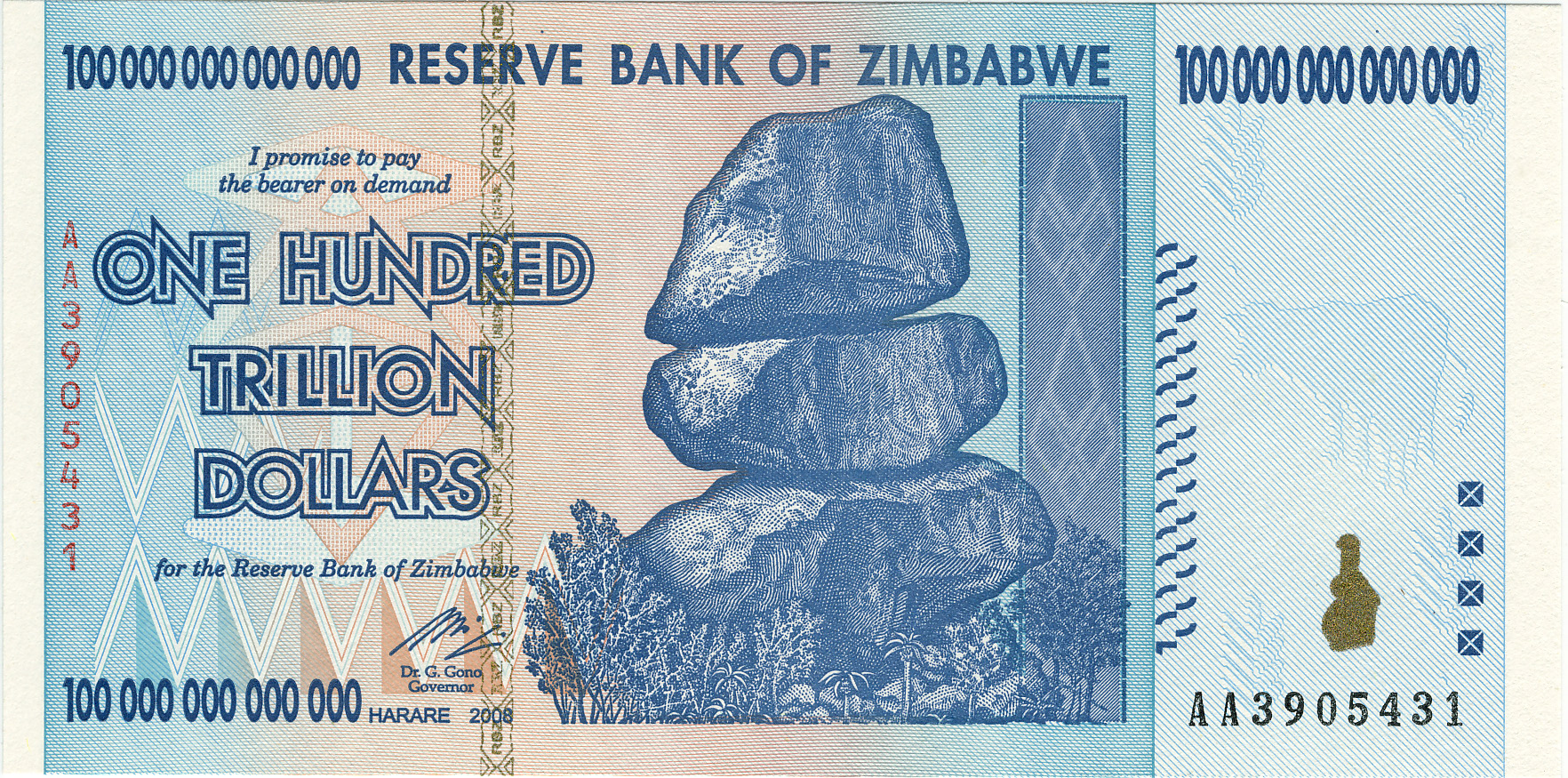
Focusing on the amount of coins you are mining or the coin supply is a joke. It's like praising Zimbabwe for producing 100T dollar notes, or the post WW1 Germany for having so much money you can build toy houses with them.

Market cap is deceptive


A lot of people rely on the market cap to determine which coin is the most valuable and worthwhile. Just have a look at CoinMarketCap. At the moment we have Bitcoin leading the market cap of about $10B, followed by Ripple at $1.2B.

Right at position number 2, we have an issue calculating the market cap - Ripple's available supply is listed at 35B XRP, although its total supply is shy of 100B XRP. If we calculated the market cap blindly, we should take the total supply and multiply it by the current price (0.0035 USD/XRP), which would net us $3.6B, rather than $1.2B.

The market cap is a poor metric for a coin with a highly-centralised supply. As Peter Todd jokingly put it - just mine a large amount of coins, sell a few of them at a high price and you've got a huge market cap.

It would be really hard to create some metric that can measure how valuable a cryptocurrency network is - market cap can be inflated, volume can be faked or hidden, you can't ever know how much of the coin supply is held by a handful of people with a million addresses, etc.

Inflation is not growth


In the past I've seen some deceptive advertising for a proof of stake coin that claimed it was a savings currency. They justified it by essentially saying - "buy our coin, then you can stake it and earn X% per year with it". While on surface it might appear so - if I start with 100 coins and at the end of the year I get 110 coins, then I'm 10 coins richer, right?

That works only on paper. If the market cap for the cryptocurrency remained unchanged and everyone got their 10% more coins, then you're right where you started - you own the exact same percentage of the economy as you used to. The inflation ate your earnings.

In economics, there is an important distinction between nominal and real interest rates. If I take a loan at 5% (nominal) interest rate, but the inflation is at 3%, then I effectively only pay a 2% (real) interest rate on the loan. Each year the principal of my loan has lower and lower purchasing power even if the number remains steady. The same is true for proof of stake inflationary coins - you're not earning anything with them, unless the pace of your earnings is faster than the overall inflation of the network.

A coin will only net you revenue if its equivalent of "real GDP" increases:


If you're not ahead, you're losing money


In an inflationary currency, if your supply of coins is growing slower than the average coin supply, you are essentially losing money. Earning 5% interest in a currency with 10% inflation means you are losing 5% on your investment in an ideal economy. In a real-life scenario, the markets would most likely be swayed a lot more by the speculation on the coin and whatever hype it can muster.

This point usually has low impact on most coins, but it seems to be exemplified with OneCoin's splits and tokens, assuming we would treat the coin as a real cryptocurrency and not a scam. In OneCoin, you can buy different packages that each come with a different amount of tokens and splits. If you buy the cheapest package for 110 EURO you get 1000 tokens and one split, but if you decide to spend 27'500 EURO, you get 300'000 tokens and three splits. This means that not only do you get about 20% discount on tokens when buying them in bulk, buy you can also split them more times (which I'm guessing would give you more mining tokens or something, I'm not sure). Because of this, if you're buying anything shy of the top-tier package, you're already falling behind. I guess that's why you can find a lot of "strategies" for buying the tokens everywhere...

Same goes for the doubling event, wherein everyone's coins got doubled (since 100% inflation equates to 100% growth or something...). If you missed that event, your purchases are only worth 50% of what they would've been before that event in proportion to the entire market. You can't ever catch up.

If you're late, you're paying the early adopters


Unless we're talking about cryptocurrencies with a flexible supply denominated in fiat, anyone adopting late is essentially paying the early adopters. In some cases, that's pretty justifiable - when Bitcoin was still fresh and nobody knew if it had staying power, you needed a lot of people to devote their time and energy into developing the infrastructure everyone relies on today.

However, if you look at something like OneCoin that relies heavily on hype and even pays you in a pyramid-like structure for referrals, you have to be really weary when buying into it.

This is why a lot of people in the crypto world despise premining and fast maturing coins - a few people hold a lot of coins and they get to reap the bulk of the money from anyone buying into the network. When the jig is up, they can cash out and it's the late adopters that get to hold the bags.

If OneCoin was an honest coin, I can see some people getting rich if and when the coin starts getting publicly traded and people can start dumping their coins. As it is now, it is likely that everyone with the coins will be holding the bags while the people behind the coin will be the one with the money.

Conclusions


Coin supply does not matter, market caps can be deceiving, nominal growth does not matter - only real growth, don't buy into scams.

Monday, October 3, 2016

Problems with big numbers in crypto - how Bitcoin dodged a bullet

Problems with big numbers in crypto - how Bitcoin dodged a bullet

Recently, the infamous OneCoin made news once more in the Bitcoin circles after their OneLife mastermind stream. One of the more interesting things mentioned was the previously announced blockchain reset, coin doubling and increase in coin generation speed. This is supposed to mean that OneCoin is getting more valuable, but once again, that's not how blockchain works - big numbers don't mean big money. But let's start from the beginning.

Bitcoin coin cap


As everyone knows by now, Bitcoin has a coin cap of around 21'000'000 coins. Each coin can be broken down into 100'000'000 satoshis, and that number can be further sub-divided in the future should the need arise. So for practical needs, Bitcoin has a final supply, and a nigh-infinite divisibility, as opposed to fiat currencies that are often nigh-infinite in supply, but finitely divisible.

The hidden genius of Bitcoin is very subtle when it comes to its coin cap and its precision that a lot of coin developers often miss entirely.

Sure, Bitcoin might not have a mathematically beautiful block reward (say, a power of 2 that halves every four years so that we can get a beautifully round number in the end), but it's still easy for programmers to work with. In financial computer science, precision is everything. A balance of $3.50 would not be represented in a database as a floating point number - those are imprecise. It would be an integer number, like 350 cents, or 35'000 hundredth of a cent if you need to get more precise. This makes sure that you can add, subtract and multiply those numbers all day long and you will always be right down to a penny.

Same goes for Bitcoin. Every transaction specifies exactly how many satoshis to transfer and to whom. The number is encoded in a 64 bit unsigned integer, meaning it can precisely express numbers between 0 and 2^64 (18'446'744'073'709'551'615). Even if you take all of the bitcoins that will ever exist and subdivide them into satoshis, you will get a number smaller than 2^51, meaning no matter how many coins you move back and forth, you will never lose precision or overflow the system. Moreover, the numbers can also be represented precisely with double-precision floating points (which has a precision of 2^52 for a fraction).

Other coins and their supply


Other coins have often toyed with different block reward schedules and thus different amount of coins.

Ripple is perhaps the most popular coin with a high coin supply, capping off at 100B XRP even. Their coins subdivide into 6 decimal places rather than 8 - this gives them an upper bound of under 2^57 units (if they instead went for 8 decimal places, they would be under 2^64 and wouldn't fit into signed integers). So they are fine in that regard, but they start to run into a problem when trying to express the units as floating points - they are only precise up to 2^52, or about 15 significant digits.

Same story with Dogecoin - currently sitting at 106B units with 8 decimal place precision, which is enough to start breaking the JSON API developers use. Bytecoin, sitting at 181B coins barely fits into 64 bit integers and FedoraCoin, the coin with the highest listed coin supply on CoinMarketCap breaks that limit with 438B coin supply, needing at least 66 bits to be fully represented.

OneCoin


So where does OneCoin sit in all of this? Lets assume they are like Bitcoin with 8 decimal places (and not just some made-up numbers in a spreadsheet...). They currently boast having 2B coins and mining 2.19B coins per month, giving us less than 2^58 - too big for doubles, but still manageable for ints. In about 85 months of mining, their coin supply will reach 185B and cross over 2^64. That is a long after they plan on "going public with their coin" in Q2 2018, whatever that would mean.

Conclusions


When designing a cryptocurrency, there are many hidden pitfals one has to keep in mind and try to avoid. One might be tempted to create a currency with large numbers to give off an illusion of value where there is none. However, for practical reasons, you want to keep the numbers in your system within a reasonable range so the developers working with your coin won't have to deal with numbers too big to represent.

OneCoin might still be in the clear, at least as clear as Dogecoin is, but one more "blockchain restart" coupled with increased mining speed and they will be soon crossing the computer science boundary, at least assuming the system is legitimate to begin with.

Next up - why big numbers don't mean big money...

Thursday, September 29, 2016

DECENT - a torrent blockchain presale

DECENT - a torrent blockchain presale

Recently, I was contacted by a fellow Bitcoiner and informed about some possible shady goings-on on the DECENT platform. Reportedly, the platform has raised 5352BTC (3.2M USD equivalent) in its token presale, but the product appears to be on some shaky grounds. Lets have a look at what we can find out about the platform, the presale and have a look at whether there is something shady going on...

The Whitepaper


Any self-respecting blockchain project styles itself after Bitcoin and releases a whitepaper early on. Decent is no exception (#liberateyourself on every page...).

The paper starts with criticising Bitcoin for BOTH its low transaction throughput, and its large blocksize. Wouldn't it be nice if one could have a higher transaction throughput with a lower data footprint? Unless you start pruning old data, it won't happen. But that's apparently "some childhood diseases" Bitcoin has.

"Unfortunately, in spite of more than 6 years of its existence [Bitcoin] did not reach a position it could have attained mainly due to the imperfections in its architecture and design."

In comes Decent. Saving freedom of speech, solving the issue of authors having to figure out how to monetise their content, drive traffic to their sites, deal with Amazon's pay cut, etc. You can use it to publish "any text, picture, video or music content" (and even software) and "no third parties can control or influence the content".

The platform is characterised by being:
  • Independent - owned by the users and "will never be affiliated with any economic, media, or political party"
  • Borderless
  • Stable - not dependent on any single server
  • Fair - everyone starts at the same level and build up their reputation
  • Profitable - users can buy content directly from the authors and there is no cut taken by Decent
  • Spam Free - content publishing is expensive for spammers
  • Secure & Anonymous - authors can publish the content anonymously
  • Recommendations-enabled - readers that purchased the content can embed their feedback into the blockchain


While describing how the protocol works, we also learn that the application will be using the bittorent protocol with a distributed tracker to distribute its content. The torrent is downloaded by the "publishers" that charge a fee for storage and bandwidth. For encrypted content, the decryption keys are also distributed to the publishers.

Upon hearing what kind of content the platform will support, the cynic in me instantly reached two conclusions - a lot of the content, especially the movies and music, will be pirated like on current torrent websites, and a lot of the software content will contain malware. I somehow doubt I will be proven wrong...

So all in all, it looks like the system will use a blockchain to keep track of who paid for what content, while the actual content will be distributed over torrents. All in all, it looks like a poor man's version of MaidSafe or Storj, also somewhat similar to the Alexandria project. While those platforms focused on creating their own storage solutions paired with the blockchain, Decent appears to just mash Bitcoin and torrent technologies and produce something that's less than a sum of its parts.

A somewhat more usable solution would just focus on augmenting the torrent architecture without burdening it with a proprietary blockchain. You could use Factom or Ethereum to publish the magnet links, have some proof-of-payment solution to request the torrent data for paid content, or even just rely on donations from people that consume your content. Building one's own blockchain just to manage new tokens proves once again, a solution looking for a problem.


The token presale


Like a lot of projects in the crypto space, Decent is raising money through a token presale. To buy the tokens, you need to register an account on Decent's portal and pay bitcoins into a provided address. The tokens are distributed into the account and will later be available for withdrawal on the network proper. At the moment there doesn't appear to be an option of transferring the balance between accounts, so one is unlikely to be able to trade or sell the tokens before the network goes live.

Since it looks like Decent is handling all of the balances and not acting as a client-side wallet provider like Blockchain.info (that is, Decent probably handles all of the balances themselves), this can get really hairy for them from the regulators' perspective. Were they located in the USA, I would stay away from the service after what happened to Ripple Labs. Since the service does not seem to gather KYC information, it might be in a legal grey zone. Not being able to send the tokens around might actually be a benefit for the company - the token appears as a less of a security this way.

At any rate, the gathered bitcoins end up in 2-of-3 escrow with Coinbase. The three people responsible for handling the funds are:

  • Matej Michalko, the founder and director of Decent. Also, a co-founder of five different Bitcoin conferences (I suppose that is a new, fancy term for "organizer" nowadays), and a co-founder of two other crypto-related companies
  • Tibor Tarabek, reported to be the "Founder of Microsoft Slovakia", although his LinkedIn profile lists him only as a General Manager in years 1995-2000 (and also a "General Manager" of some "bitcoin, s.r.o." company between years 1992-1994, 16 years before Bitcoin was released!)
  • Vasylchenko Alexander, former director of Mycelium in years 2012-2014


It is a bit strange that the founder of Decent is a co-signer of the escrow if you want to show that you can deliver on the project's promises. Find a few reputable Bitcoin people and use them for the entire escrow to show the release of funds is unbiased. Currently, all you need is one of the two extra people to co-conspire and you have full access to the 3.2M USD. While I might not know the reputation of mr Tarabek in the Slovakian Bitcoin space, his apparent lack of involvement with Bitcoin-related projects doesn't speak well to his ability to objectively judge a project like this.

Lastly, storing token presale funds in Coinbase, a company known for helping US authorities shut down torrent-related websites, doesn't bode well for the security of the funds. No KYC, token presales and US don't mix well...

All in all, I'm very dubious about how well the presale is handled. While it's not completely shady, I would not be surprised if the tokens get released before the project is finished or worse. To anyone that has purchased the tokens so far - hope for the best, prepare for the worst.

The Team


All in all, what makes or breaks a project is often the team. Let's look at who the Decent team is compromised of...

The Founders consist of:

  • Matej Boda, who seems to be rather fresh out of university without much prior experience
  • Matej Michalko, the aforementioned co-founder of a lot of crypto-related projects. He appears to be business-focused
  • Wayman Kwan, a venture capitalist
So mostly business-focused founders. Let's look at the developers in the team:


  • Josef Sevcik, with background in Business Administration, Informatics and telecommunication
  • Bohdan Skriabin, a cryptographer still studying at a university
  • Lubos Novotný, an UX / designer
  • Stanislav Cherviakov, "a tech expert with a mathematical background" with experience in fintech, etc.
  • Vladimir Dubinin, a mathematician with a computer science degree
  • Anatoly Ressin, a programmer

And a lot of other advisers, ambassadors, etc. All in all, the development team is a bit mixed, having a few people that appear to have a lot of relevant experience, and some that are just starting out. The company also appears to be looking for a senior developer and a junior developer, both with a negotiable compensation payable in "other".

It looks like there are about 13 people making up the company proper. That can give the company a pretty high burn rate before any technical prototypes have been developed, but the costs may be rather low if the majority of the team is located in Slovakia.

Codebase


So far, Decent doesn't appear to be publicly owning up to any publicly available repositories on their website. However, the bitcoiner that prompted me to investigate the company pointed me in a direction of a github repository posted by Josef Sevcik, one of the developers on the Decent Team. It looks like a possible prototype of the Decent platform. The codebase appears to be based on Peershares with a small amount of changes (a few file diffs: 1, 2, 3).

Basing the codebase on proof-of-stakes based currency informs a lot of new things about the project that haven't really been mentioned on the project's website - the initial allocation of tokens (how much is being kept by the company and developers) can be really important when it comes to earning block rewards for example.

Conclusions


All in all, the Decent looks like an underwhelming solution looking for a problem. It is very unlikely the platform will solve all of the problems it sets out to fix - nobody will want to switch over to a new platform, use a new currency to get a glorified paywall. Focus on presaling the tokens doesn't seem to be improving the solution, as is often the case. Raising 3.2M USD before anyone has seen a prototype of the platform is similarly ludicrous. The tokens have little to no value during the presale - you can't trade them for speculation, you will only be able to use them once the platform launches, and there doesn't appear to be any special use for the tokens in the final system other than paying for things. I somehow doubt the platform will have 3.2M USD worth of content on it for years to come, so pre-purchasing a token now to be able to pay a movie for a few dollars or a blog article for a few cents a year down the line sounds like an awful proposition.

The escrow holing the coins doesn't appear to be following the industry's standards. It is not completely shady, but it could inspire more confidence.

The team behind the project looks fine - no "blockchain rockstar" stands out, but it seems to have everything needed. It is good that the company advertises its contact information, including physical addresses.

From the rumours I heard from a few fellow bitcoiners closer to the project, the company seems to be aggressively pushing for its presale with just a forked open source repo to back it up.

So in conclusion, the project doesn't look like it can live up to its own hype. The approach is rather naive, even if it can be fully realised. I see no reason to back it financially, and for anyone that has - I would like to know why? The token can't be traded, sold, speculated on until the project launches, which makes it a rather risky proposition.

The Bitcoin Bullshit List

Your Crypto Idea Will Not Work

Your post advocates a new:
(x) Altcoin
(x) Wallet
(x) Distributed data storage

Your idea will not work.  Here is why it won't work.

(x) Your target audience is too small to support the project
(x) There is already a product on the market that does exactly what you’re doing, but ( ) faster / (x) cheaper / (x) better / (x) is more established / ( ) ______________
(x) Your project will not be compliant with the current (x) KYC / ( ) AML / ( ) gambling / (x) DMCA regulations
(x) Your solution is worse than general-purpose computing hardware / software
(x) Your presale tokens have no economic value

Specifically, your plan fails to account for:
(x) The existing regulations
(x) Public reluctance to accept weird new forms of money
(x) The known security exploits of the existing Internet services
(x) The human factor
(x) The problem of distinguishing between a human and a bot

and the following philosophical objections may also apply:
(x) Nobody likes DRM
(x) Ideas similar to yours are easy to come up with, yet none have ever been shown practical
(x) Feel-good measures do nothing to solve the problem
(x) I don’t trust YOU with the money

Furthermore, this is what I think about you:
(x) Sorry dude, but I don't think it would work.


Bitcoin Bullshit Tier


You are advertising a new Bitcoin / crypto related project. Based on the information provided, you have reached the Bullshit Tier of 3 for the following reasons:

Bitcoin Bullshit Tier 1 - marketing babble, technology misunderstanding
(x) “Blockchain”
(x) “As good as / better than Bitcoin”

Bitcoin Bullshit Tier 2 - willful misinformation, bait and switch
(x) Claiming your project can accomplish something hard without a clear explanation of how to do so

Bitcoin Bullshit Tier 3 - Many red flags
(x) Token IPO

Tuesday, September 27, 2016

Global Reserve Currency - Special Drawing Rights vs Bitcoin

Global Reserve Currency - Special Drawing Rights vs Bitcoin

Earlier this month, the G20 summit was held in China. One of the more interesting topics discussed, was the addition of Chinese yuan to the SDR - Special Drawing Rights. The topic of SDRs is rather important, but it doesn't seem to be discussed all that widely in the crypto community, so I figured I would cover it today.

Special Drawing Rights


Special Drawing Rights, or SDRs, are supplementary foreign exchange reserve assets defined and maintained by the International Monetary Fund (IMF). They were created in 1969. SDRs are allocated to countries by the IMF, and private parties do not hold or use them. The value of SDRs is based on a weighted basket of currencies (currently, 41% USD, 31% EUR, 11% CNY, 8% JPY and 8% GBP, worth about 1.39USD/SDR).

Special Drawing Rights are posed to replace the dollar as the world reserve currency. They serve well as a unit of account (due to lower volatility), can work well in international law (to have an objective measurement of value across multiple countries), and some countries even started pegging their currency to the SDR (due to increased transparency).

While the IMF and SDRs might not be an entirely ideal solution to creating a new, global currency (with US having a veto power and failing to ratify some reforms for example), it might be a step in the right direction.

Where SDRs fall short


While the Special Drawing Rights are an interesting idea, they fall short in a one key area - they appear to be inaccessible for anyone short of a government. This can limit how useful the currency can be for say, creating international settlement, or using it as a measurement of value for corporations or even individuals.

If SDRs were a publicly available and tradable currency, it would be really interesting to see it used for pricing items, wages, etc. to counter currency wars. If your wage is pegged at 3000USD/month, whether USD goes up or down, you're paid the same amount of dollars. But if your wage was instead set at 3000SDR/month, you would receive the same value each month, no matter if it meant you got 2500USD when the dollar is strong, or 3500USD when it was weak. This could give anyone a protection from the government's meddling.

Crypto SDRs


Creating a currency based on a basket of other currencies is also not an entirely new idea in the crypto space either. Paul Grignon (author of Money as Debt) has described his take on the idea as Digital Coin back in 2009. A part of the system, called Perpetual Coin, would initially be issued based on a value of a basket of currencies. Unfortunately, the project never left the conceptual phase, and the website is down now, so it is unlikely we will see it ever implemented...

Other than that, there doesn't appear to be an SDR-pegged cryptocurrency out there. This might perhaps be due to the fact that we already have a better alternative to the Special Drawing Rights - Bitcoin. What it lacks in stable value at times, it more than makes up in terms of being all-inclusive and, at least so far, immune from government influence.

It wouldn't be hard, however, to create an SDR-Coin - it could function like Tether, or perhaps more accurately, like BitUSD since you couldn't exactly withdraw the coin. The main problem for a centralised issuer would be keeping the valuation of the currency stable, especially in periods where the basket of currencies is adjusted. Other than that, once the currency itself is created (and I would almost bet we would see someone make the currency after the article is published - 700+ cryptos is not enough after all), it would be interesting to see it start being used internationally. Perhaps we would finally see what is the real demand for SDRs for corporations and real people, rather than just governments. With any luck, this might just hurry the demise of the USD or "petrodollar" hegemony.

Conclusions


Special Drawing Rights are an interesting take on creating a new global reserve currency. While it is currently only accessible to governments, it could be very useful for corporations and end-users. For the time being, Bitcoin is the most accessible alternative for the rest of us.